Airbnb Cleaning: The Service Page That Prints Money
Most cleaning companies do Airbnb turnovers but have no page for it. With 1.5M active US listings, the revenue gap is massive.
It’s 11:14 AM on a Saturday in Miami. A guest just checked out of a two-bedroom Airbnb. The next guest arrives at 4 PM. The host opens Google on her phone, types “Airbnb cleaning near me,” and starts clicking. The first result is a generic cleaning homepage — residential, commercial, carpet. No mention of turnovers. The second site loads slowly and offers a phone number she can’t wait on. The third has a dedicated Airbnb cleaning page with per-unit pricing, same-day availability, and a booking button. She books in three minutes. The other two never knew she existed.
We’ve audited over 1,200 cleaning company websites across 11 states. The vast majority have no dedicated Airbnb or vacation rental cleaning page. Not a section. Not a bullet point. Nothing. In a country with 1.5 million active Airbnb listings (AirDNA, 2025) and a short-term rental market growing at 11.2% CAGR, that’s not a minor oversight. It’s a revenue category most cleaning companies aren’t even competing in.
Most cleaning websites have no Airbnb page at all
Across our national cleaning market audit, the pattern is stark. Most cleaning company websites treat their online presence like a digital business card — a phone number, a few stock photos, a generic services list. The average site scores 37 out of 100. Dedicated service pages for high-value segments like vacation rental cleaning barely exist.
Think about what that means for a host managing turnovers in a competitive market. She searches for a specialist. She finds websites that say “We clean homes and offices!” None of them acknowledge that Airbnb cleaning is a different job with different urgency, different pricing, and different expectations.
The companies that do build a dedicated Airbnb page are splitting all that demand among themselves. In most cities, we’re talking about a handful of companies capturing traffic the rest don’t even know they’re losing.
The short-term rental cleaning market keeps growing
There are 1.5 million active Airbnb listings in the US alone (AirDNA, 2025). 75% of hosts outsource their cleaning (Guesty, 2024). That’s over a million listings that need third-party cleaners — not once, but repeatedly, every week. The average host manages 1.5 properties and needs 2-4 turnovers per week in popular markets.
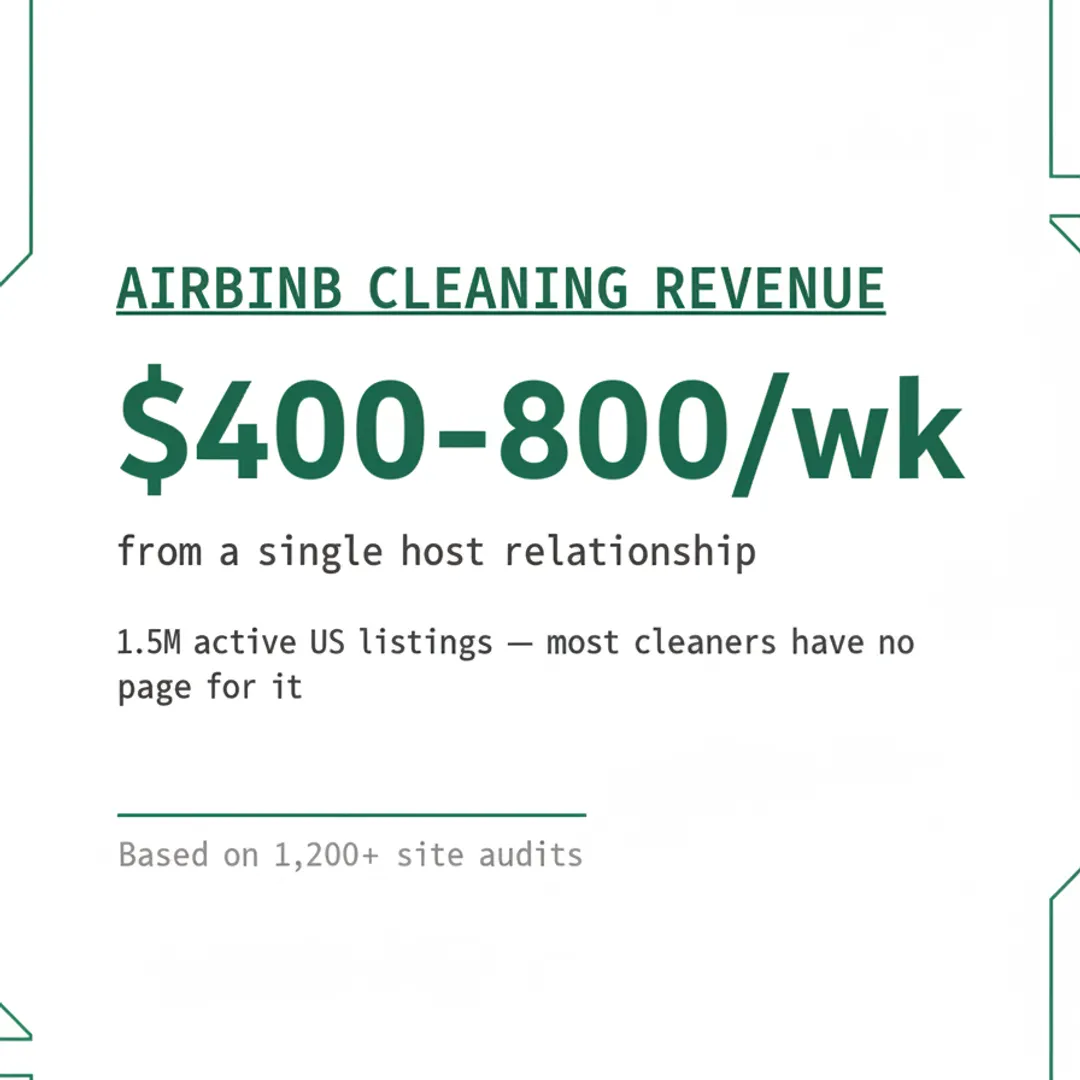
Do the math on a single host relationship. At $80-$200 per turnover depending on unit size, one host can generate $400-$800 per week in cleaning revenue. That’s $20,000-$40,000 per year from a single client. Unlike one-time deep cleans or move-out jobs, turnover cleaning is recurring by nature. The bookings don’t stop as long as the listing is active.
The broader residential cleaning market hit $16.27 billion in 2025 (Grand View Research). Short-term rental cleaning is one of its fastest-growing segments, driven by the 11.2% CAGR in the vacation rental market. Search volume for “Airbnb cleaning near me” has grown over 300% since 2019. The demand isn’t theoretical. It’s showing up in Google right now — and most cleaning companies aren’t there to catch it.
The revenue gap between residential and Airbnb cleaning compounds with every additional host relationship. A residential client books once every week or two. An Airbnb host sends you multiple jobs per week — automatically, indefinitely.
Hosts care about reliability, not price
Here’s what most cleaning companies get wrong about the Airbnb market. They assume hosts are price-shopping. They’re not. Hosts’ number one complaint about cleaners is reliability — not cost.
Why? Because a missed turnover isn’t an inconvenience. It’s a crisis. Same-day turnovers are the norm in popular markets. The window between checkout and check-in is typically four hours. If the cleaner doesn’t show, the host faces a bad review, a partial refund, or a cancelled booking. One missed clean can cost a host $200-$500 in lost revenue and reputation damage.
That’s why hosts pay a premium for dependability. A cleaner who shows up every time at $150 beats a cheaper option at $100 who cancels twice a month. Professional cleaning also correlates with higher guest ratings and more bookings — which means hosts who invest in reliable cleaning earn more from the platform overall.
Your Airbnb page needs to communicate reliability, not just services. A page that says “we offer cleaning” doesn’t cut it. A page that says “same-day turnovers, photo confirmation before check-in, never missed a booking in 14 months” — that closes the deal.
What a high-converting Airbnb cleaning page includes
The page needs to answer five questions within seconds. Hosts are managing multiple properties, often from their phones, usually under time pressure. They won’t read a wall of text about your company’s founding story.
Turnover-specific pricing by unit size
Not “call for a quote.” Per-unit rates by bedroom count. A studio costs less than a three-bedroom. Show the math. 73% of cleaning websites have no pricing page at all — listing turnover rates immediately puts you ahead of nearly everyone.
Same-day and next-day availability
Hosts deal with early checkouts, last-minute cancellations, and double bookings. If you can handle same-day requests, say it clearly. If your cutoff is 10 AM for same-day, state that too. Specificity builds more trust than vague flexibility.
Linen and restocking add-ons
Sheets, towels, toiletries. Many hosts want a one-stop solution. If you offer linen service as an add-on, price it separately on the page. This signals you understand the full scope of turnover work.
Photo documentation
Some hosts want proof that the unit is guest-ready before check-in. If you photograph the finished clean and send it to the host, mention it. This is a differentiator that almost nobody advertises.
Online booking with calendar integration
Hosts manage multiple properties across different platforms. They don’t have time for phone tag. 74% of cleaning websites have no online booking — the bar is remarkably low. A booking system that lets hosts schedule recurring turnovers across multiple units wins the account.
Vacation rental markets where this matters most
You’d expect cleaning companies in tourism-heavy cities to have figured this out. They haven’t. We pulled data from vacation-rental-heavy markets in our audit, and the gap persists even where Airbnb demand is highest.
Florida alone accounts for a disproportionate share of US vacation rentals. Cities like Orlando, Miami, and Tampa see year-round turnover demand from beach rentals, theme park stays, and snowbird seasonal traffic. Yet Florida cleaning companies score barely above the national average in our audits.
Las Vegas tells a similar story. Thousands of short-term rental units serve 40 million annual visitors. The cleaning companies serving that market score among the lowest in our data. The websites aren’t just missing Airbnb pages — they’re missing basic conversion elements like trust signals, pricing, and contact forms.
Texas markets like Houston and Austin perform slightly better on overall site quality, but the Airbnb page gap remains wide. These are cities where short-term rental demand is growing fast and the first cleaning company with a strong dedicated page will own that search traffic.
The demand intensity drops as you move from vacation-heavy markets to mid-size metros — but even a mid-size city with moderate Airbnb activity represents easy revenue for any cleaning company willing to build the page.
One host relationship compounds into serious revenue
Turnover cleaning isn’t a one-off transaction. It’s a recurring revenue stream that compounds over time. A host who trusts your team with two properties today will hand you the third without a second thought. You don’t need to market to them again. You just need to not drop the ball.
The average Airbnb host manages 1.5 properties (AirDNA, 2025). Property managers often handle five, ten, or twenty. A single property manager relationship at scale can generate $9,000+ per month in cleaning revenue. That’s $108,000 annually from one client — with zero customer acquisition cost after the initial booking.
Compare that to standard residential cleaning. A biweekly residential client generates maybe $180 every two weeks. That’s $4,680 per year. You’d need 23 residential clients to match the annual value of one mid-sized property manager. And every one of those 23 clients required a separate marketing touch, a separate onboarding, a separate relationship.
This is why the missing Airbnb page is so costly. It’s not just one lost booking. It’s a lost relationship that would have generated recurring revenue for years.
The compound effect of a dedicated page plus booking plus pricing plus trust
Here’s where the audit data gets interesting. The individual gaps we track — no Airbnb page, no pricing, no booking, no trust signals — don’t operate in isolation. They compound.
A cleaning website missing all four is invisible to the Airbnb host segment. But a site that has all four creates a conversion path that works on autopilot:
- Dedicated Airbnb page ranks for “Airbnb cleaning” + city name
- Turnover pricing answers the cost question immediately
- Online booking lets the host schedule without a phone call
- Trust signals (bonded, insured, reviews) remove the last objection
The average cleaning website scores 37 out of 100 in our data. The average Google rating across audited companies is 4.8 stars. That means most companies have already earned the trust — they’re just not displaying it alongside a clear booking path. They’ve done the hard part. They’re skipping the easy part.
46% of cleaning websites lack visible trust signals entirely. They’ve earned the reviews but buried them on Google while their website shows nothing. Pair that with missing pricing and no booking, and you’ve got a site that asks the visitor to take multiple leaps of faith before making contact. 65% don’t even have a contact form. At that point, what’s the site actually for?
The window is still open, but it’s closing
Right now, the Airbnb cleaning page gap is wide. In most local markets, one or two cleaning companies have built a proper page. Everyone else is invisible to hosts who search for turnover-specific service.
That’s a window. How long will it stay open?
The short-term rental market is growing at 11.2% CAGR. More hosts are entering. More cleaning companies will eventually add these pages. The franchises and tech-forward startups entering the market are building them from day one. The established companies who wait will find themselves outranked by newer competitors who understood content strategy from the start.
The companies building this page today rank first, build host relationships first, and become the default recommendation in local Facebook groups and host forums. Once a property manager finds a reliable cleaning partner, switching costs are high. They don’t want to train a new team on their property’s quirks, their linen preferences, their restocking list.
First mover advantage is real in local service SEO. The company that ranks first for “Airbnb cleaning [city]” today will be very hard to displace a year from now.
One page changes the math
Consider what we’ve covered. 1.5 million active Airbnb listings in the US. 75% of hosts outsource cleaning. Average turnover rates of $80-$200 per clean. A single host relationship worth $400-$800 per week. A short-term rental market growing at 11.2% annually. And most cleaning companies don’t have a single page targeting any of it.
The move-out cleaning page gap is similar — a high-value segment that half the industry ignores. But the Airbnb gap is arguably worse because the revenue is recurring. Every week without that page is a week you’re not capturing host relationships that would have paid you for years.
Check how your website stacks up against the top performers in our data. Run a free audit — most sites score 37 out of 100, and the missing Airbnb page is just one of the gaps.
The host with four hours before the next guest is searching right now. She’s going to find someone. Make sure it’s you.
Keep reading
Want to know your score?
Drop your URL — full report in 48 hours.
We're on it.
Report in your inbox within 48 hours.