Why 74% of Cleaning Websites Have No Online Booking (And What It's Costing Them)
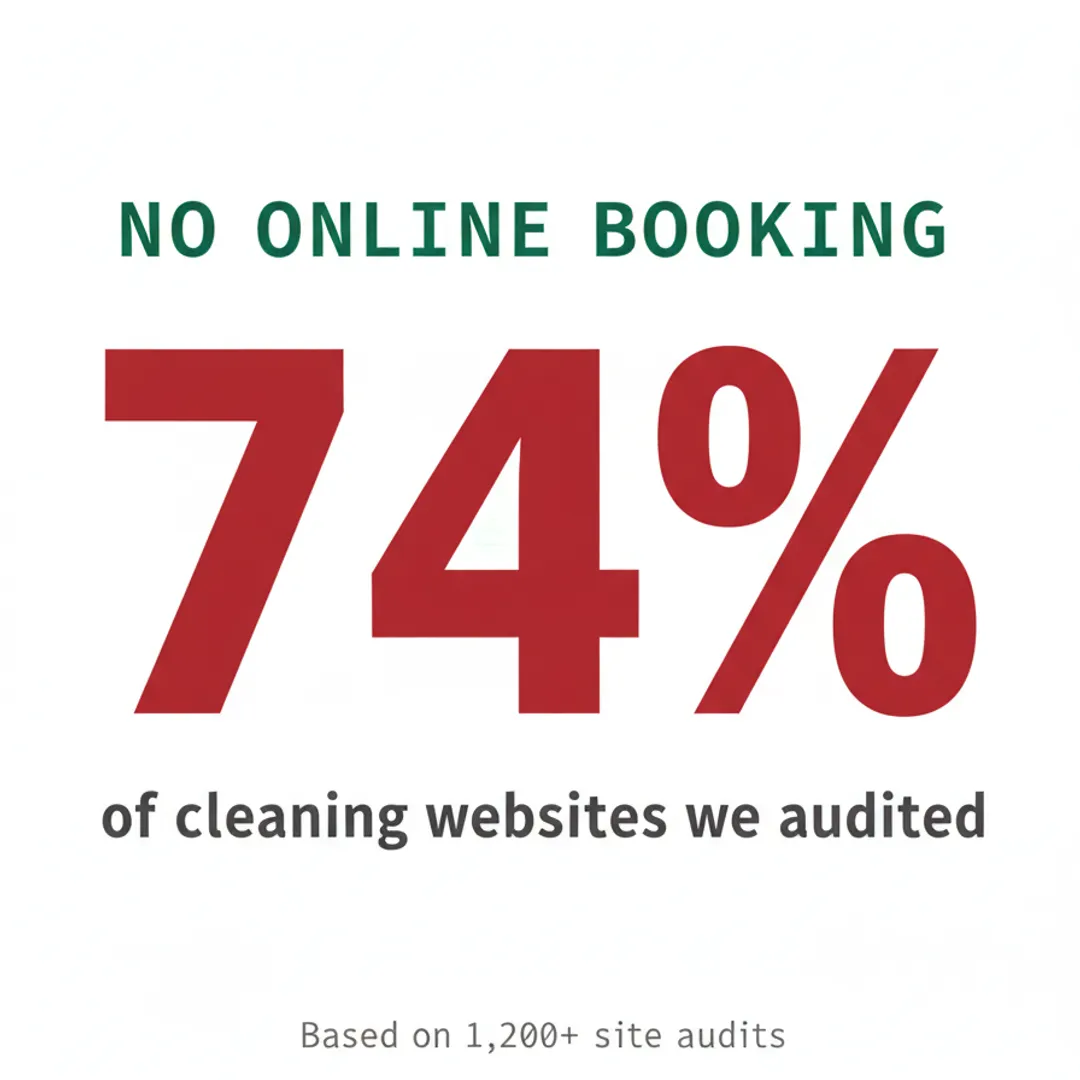
We audited 1,200+ cleaning company websites and found 74% have no online booking. With 46% of appointments now booked online, that gap is costing real revenue.
It’s 11:47 PM on a Tuesday. A homeowner in Orlando just Googled “house cleaning near me,” found a company with perfect reviews, tapped the site — and hit a wall. No booking button. No quote form. Just a phone number they can’t call until morning. By 8 AM, they’ve already booked someone else.
This isn’t a hypothetical. We’ve audited over 1,200 cleaning company websites across 11 states, and the pattern is staggering: 74% have no online booking or instant quote option. In an industry where 46% of all appointments are now booked online (Zipdo, 2025), that’s not a design oversight. It’s a revenue leak.
The residential cleaning market hit $16.27 billion in 2025 and is growing at 9.17% CAGR (Grand View Research, 2025). Yet the average cleaning website we audited scored just 37 out of 100. The gap between market opportunity and website readiness has never been wider.
This post breaks down what we found, what it’s costing these companies, and what the fix actually looks like — backed by every data point we’ve collected.
The booking gap is worse than you think
Across our national cleaning market report, one signal stood out above everything else: most cleaning websites aren’t built to convert visitors into customers. They’re built like digital business cards from 2014.
Here’s the breakdown from our audit:
| Feature | % of Sites Missing It |
|---|---|
| Online booking or instant quote | 74% |
| Pricing page | 73% |
| Contact form | 65% |
| Clickable phone on mobile | 62% |
| Customer reviews on site | 51% |
That’s not one problem. That’s five compounding problems. A visitor who can’t book, can’t see prices, can’t fill out a form, can’t click to call, and can’t read reviews — what exactly are they supposed to do?
The answer: leave. And 53% of visitors do exactly that when a page takes more than 3 seconds to load (Google, 2023). Add a missing booking option on top of slow speed, and the drop-off gets worse.
After-hours visitors are the most valuable — and the most ignored
Phone calls convert 30% faster than form submissions (Invoca, 2024). That’s a real advantage during business hours. But what happens at 9 PM? Nothing. The call goes to voicemail. The customer moves on.
94% of consumers say they’re more likely to choose a service provider that offers online scheduling (GetApp, 2024). That’s not a preference — it’s an expectation. And cleaning companies that offer 24/7 booking report a 37% increase in total appointments (Acuity Scheduling, 2024).
Think about the economics. A cleaning company doing 15 jobs per week at $180 per job pulls in about $2,700 weekly. A 37% bump means roughly $1,000 more per week — $52,000 per year — just from being bookable when the phone’s off.
We see this pattern across every city we’ve studied. In our Orlando market report, over 78% of cleaning sites had no booking option. Orlando’s a transient market — vacation rentals, Airbnb turnovers, move-outs. These customers book at odd hours. They don’t wait until Monday.
The “just call us” model is breaking
Here’s what some cleaning company owners tell us: “Our customers prefer to call.” Maybe some do. But the data says the industry is shifting fast.
40% of cleaning jobs across North America were booked through apps or online portals in 2024 (IBIS World, 2024). That number was under 25% in 2020. The trend line only goes one direction.
Meanwhile, 62% of the cleaning sites we audited don’t even have a clickable phone number on mobile. So the “just call us” crowd isn’t even making it easy to call.
No-shows drain revenue that booking systems recover
Every cleaning company deals with no-shows. It’s an accepted cost of business. But the accepted rate — 10% to 20% — doesn’t have to be the actual rate.
Automated booking systems with built-in reminders (text, email, or both) drop no-show rates to 3% to 8% (Appointy, 2024). That’s not a marginal improvement. On a 20-job week, it’s the difference between losing 2-4 jobs and losing zero or one.
The math is straightforward. At $180 per job with a 15% no-show rate, a company loses roughly $540 every week to missed appointments. Cut that to 5%, and you’re losing $180. That’s $18,720 recovered annually — from a booking tool that costs $20-50/month.
Customer retention follows the same pattern. Companies using automated scheduling see 50% higher retention than those relying on phone-only booking (Housecall Pro, 2024). Recurring customers don’t want to call every two weeks to rebook. They want to tap a button.
The pricing page problem compounds the booking gap
We’ve written about this separately in our pricing page analysis, but the short version: 73% of cleaning websites show no pricing information at all. Combined with no booking, it creates a double wall.
A visitor lands on a cleaning site. They can’t see what it costs. They can’t book. What’s left? Guessing — or leaving.
Here’s how the two problems stack:
| Scenario | Visitor Action | Likely Outcome |
|---|---|---|
| No pricing + no booking | Bounces immediately | Lost lead |
| Pricing shown + no booking | Calls during business hours (maybe) | Partial capture |
| No pricing + booking available | Starts booking, stalls at cost | Abandoned booking |
| Pricing shown + booking available | Books directly | Converted lead |
Only the last scenario works reliably. And only 26% of cleaning websites we audited are anywhere close to it.
Trust signals are missing right next to the missing booking button
Would you hand your house keys to a stranger you found online — without reading a single review first? 51% of cleaning websites display no customer reviews on their site. The irony: their average Google rating is 4.8 stars (Cleaning Audit, 2026). They’ve earned trust. They just aren’t showing it.
We covered this trust gap in our piece on why “bonded, insured, background-checked” needs to be on your homepage. The companies that display both reviews and credentials see measurably better engagement in our audits.
But trust signals don’t work in isolation. They work as part of a conversion path. A five-star review next to a booking button is a conversion tool. A five-star review next to a phone number that nobody answers at 9 PM is decoration.
Texas and Florida show the pattern most clearly
We’ve audited cleaning companies in Texas and Florida more heavily than other states, and the pattern holds across both.
In Houston, 71% of audited cleaning sites had no booking. In Austin, 76%. Orlando hit 78%. These are high-growth metros with strong demand and weak supply of well-built websites.
Las Vegas and Miami — both vacation-rental-heavy markets — showed similar numbers. Charlotte and Raleigh, two of the fastest-growing metros in the Southeast, weren’t any better.
The common thread? These are cities where demand for cleaning services is high and growing. The websites just haven’t kept up.
What a conversion-ready cleaning website actually looks like
So what separates the 26% that have booking from the 74% that don’t? We looked at the highest-scoring sites in our audit reports and found a clear pattern.
The booking widget is above the fold
Not buried in a “Contact Us” page. Not hidden behind three clicks. It’s right there — on the homepage, on every service page, visible without scrolling.
Pricing is transparent, even if it’s a range
The best-performing sites show starting prices or use an instant quote calculator. “$120-180 for a standard 2-bedroom” is better than nothing. We’ve seen sites jump from a 25/100 to a 60/100 just by adding pricing and booking to the same page.
Trust signals sit next to the call-to-action
Reviews, badges, “bonded and insured” — these appear directly beside or below the booking button. Not on a separate testimonials page.
The phone number is clickable, but it’s not the only option
Mobile-first design means the phone number uses tel: markup. But it’s paired with a booking button that works at 11 PM. Both paths exist.
Speed is non-negotiable
With 53% of users bouncing after 3 seconds (Google, 2023), a booking widget on a slow page is worthless. The top-scoring sites in our audits load in under 2 seconds.
The cost of doing nothing is measurable
Let’s put real numbers on this. Take a mid-sized cleaning company doing 20 jobs per week at an average of $175 per job.
| Revenue Leak | Weekly Loss | Annual Loss |
|---|---|---|
| After-hours leads lost (no booking) | $525 | $27,300 |
| No-shows at 15% vs 5% (no reminders) | $350 | $18,200 |
| Churn from manual rebooking friction | $262 | $13,650 |
| Total estimated leakage | $1,137 | $59,150 |
Nearly $60,000 per year — from problems a $30/month booking tool could solve. These aren’t speculative projections. They’re based on the documented differences between companies with and without automated scheduling.
Is every company losing exactly this amount? No. But directionally, the gap is massive. And it compounds every month you wait.
How to fix this without rebuilding your entire site
You don’t need a new website. You don’t need to hire a developer for six months. Most cleaning companies can add functional online booking in a weekend.
Option 1: Embedded booking widget
Tools like Housecall Pro, Jobber, and Booking Koala offer embeddable widgets. You paste a snippet of code into your existing site. The widget handles scheduling, reminders, and payment.
Option 2: Standalone booking page
If your website builder can’t embed widgets, create a dedicated booking page and link to it prominently. Even a link to a Calendly or Acuity page works as a stopgap.
Option 3: Instant quote calculator
For companies that need to custom-price every job, an instant quote form beats a generic contact form. Collect bedrooms, bathrooms, cleaning type, and give an estimated range. Then let the customer confirm the booking.
The key isn’t which tool you pick. It’s making booking possible when the phone is off.
The 26% who get it right are pulling ahead
The cleaning market isn’t shrinking. At $16.27 billion and 9.17% annual growth (Grand View Research, 2025), there’s more demand every quarter. The companies capturing that demand are the ones whose websites actually work.
In our audit data, the top-scoring sites — the ones with booking, pricing, reviews, and fast load times — weren’t from the biggest companies. They were from small, local operators who made their site match how customers actually behave. Late at night. On a phone. Ready to book now, not tomorrow.
74% of cleaning websites still can’t handle that moment. If yours is one of them, the math is simple. Every night without a booking button is a night you’re paying for traffic you can’t convert.
The booking gap won’t fix itself. But a weekend of work could.
Keep reading
Want to know your score?
Drop your URL — full report in 48 hours.
We're on it.
Report in your inbox within 48 hours.